
One year after opening our EV depot, here's what the numbers say
October 2026
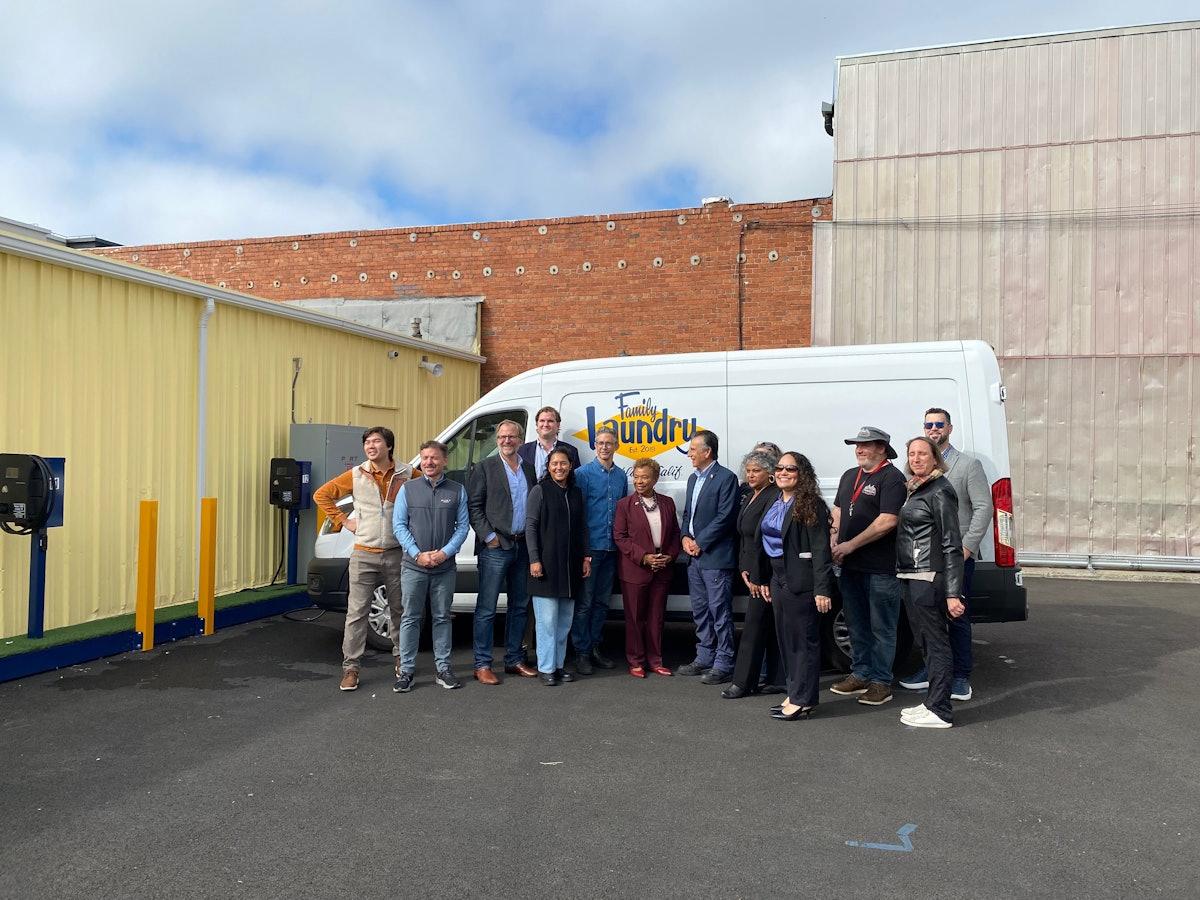
Oakland Mayor Barbara Lee announced the opening of the EV charging depot. Pictured: Mayor Lee, Family Laundry's founders, and project partners.
TL;DR
• Fuel to electric + solar: energy cost per mile down 80%, from about 40¢ on gas to 8¢.
• That's about $9,700 saved per van per year in energy alone.
• Solar on its own cut our electricity bill 43%.
• CO₂: about 14 metric tons avoided per van per year.
• Built in two steps: a 17-port charging depot in late 2025, rooftop solar in early 2026.
A year ago, we switched on our EV charging depot at our San Antonio facility in Oakland. It was the biggest investment Family Laundry had ever made: roughly $1 million for a 17-port charging depot, followed by rooftop solar to power it. The City of Oakland marked the opening as a model for the hundreds of delivery fleets operating in the city.
At the time, we said going electric had to make financial sense or we wouldn't do it. One year in, we can finally put real operating numbers behind that claim.
They're better than we hoped.
Energy cost per mile: down 80%
Each of our Ford E-Transit vans drives about 2,500 miles a month, or 30,000 miles a year, picking up and returning laundry across Oakland, San Francisco, and the East Bay.
A gasoline van doing that mileage costs about 40 cents a mile in fuel at today's Oakland prices. Our electric vans, charged at our solar-powered depot, cost 8 cents a mile. That's an 80% reduction in energy cost, and it's the number that matters most.
| Vehicle | Cost per mile | Annual energy cost | vs. gasoline |
|---|---|---|---|
| Our E-Transit, charged with solar | $0.08 | $2,400 | −80% |
| Our E-Transit, chargers only (before solar) | $0.14 | $4,200 | −65% |
| Gasoline Ford Transit | $0.40 | $12,087 | — |
| Diesel delivery van | $0.43 | $13,003 | +8% |
Gasoline: 15 mpg at $6.04/gallon. Diesel: 20 mpg at $8.67/gallon. 30,000 miles a year.
Each electric van saves us roughly $9,700 a year in energy alone compared with a gasoline equivalent. Multiply that across a fleet that runs nearly every day, and it adds up fast.
Solar is the second step in that story. With the chargers alone, electricity cost us about $350 per vehicle per month. Once solar came online, that dropped to about $200, a 43% cut in our electricity bill, and it's what took us from 14 cents a mile to 8.
And the CO₂?
A gasoline van covering 30,000 miles at 15 mpg burns about 2,000 gallons a year and puts 17.8 metric tons of CO₂ out the tailpipe.
Our vans have no tailpipe. The electricity they use isn't entirely carbon-free, even with solar, so we counted it conservatively: assuming every kilowatt-hour came from California's grid, each electric van avoids about 14 metric tons of CO₂ a year.
And that's a conservative figure. Because much of our charging actually comes from on-site solar, the real number is better.
What we've learned
Electrifying a delivery fleet is more than swapping a gas van for an electric one. You need reliable charging, enough range to finish the day's routes, and a way to keep electricity costs down. Building the depot was a big lift, and we couldn't have done it without our partners and contractors.
The savings also sit on top of real upfront costs, so we won't claim every business will see these economics on day one.
But a year in, the case for electric delivery in cities like Oakland looks strong to us. Our vans run predictable routes, come home to the same depot every night, and cover enough miles for the savings to compound quickly. Solar makes the math better still, and the depot is already sized for the fleet of 15 vans we're planning to grow into.
We went electric because we wanted cleaner air and a sound business, and we weren't willing to trade one for the other. A year in, we got both.
That's the most encouraging lesson from year one: sustainability and a sound business don't have to pull in opposite directions. Here, they pull together.
What we built, in two steps
Step one: the chargers. In late 2025 we opened the depot itself: 17 charging ports (two DC fast chargers and 15 Level 2) with energy management software, designed around Port Power's modular "Depot in a Box" and installed by Finish Line Electric. We had been charging at another of our locations, which the fleet had outgrown; the new depot gave us room to grow.
Step two: the solar. In early 2026 we added rooftop solar, installed by Citadel Roofing & Solar. A large share of the electricity going into our vans now comes from our own roof instead of the grid.
None of this would have happened without our partners. Grants came from the Los Angeles Cleantech Incubator (LACI), PG&E, and the Bay Area Air District. Port Power and Pacific Community Ventures provided technical support and financing.
About the numbers
Electricity costs and mileage come from Family Laundry operating data for our delivery fleet. Annual figures are calculated from current monthly costs, not audited full-year expenses.
Gasoline and diesel comparisons use AAA Oakland metro fuel prices as of October 26, 2026, with illustrative fuel economy of 15 mpg for a gasoline Ford Transit and 20 mpg for a diesel van.
CO₂ figures use EPA emissions factors of 8.887 kg per gallon of gasoline and 10.18 kg per gallon of diesel. EV consumption is estimated at 0.60 kWh/mile including charging losses, at the EPA eGRID California average of about 0.194 kg CO₂/kWh. The 14-ton figure assumes all charging comes from the grid and takes no extra credit for on-site solar. Manufacturing, fuel production, and other lifecycle emissions are excluded.